
Designing Sloping and Split-Level Gardens: Challenges and Solutions
At a glance
Sloping and split-level gardens can be difficult to navigate and use, but thoughtful design can turn those changes in height into one of the garden’s greatest strengths. By planning the levels, routes, drainage, structure and planting together, an awkward slope can become a series of connected, practical and beautifully planted spaces.
A sloping garden often presents the same frustrations: there may be nowhere level to sit, steps feel awkward, lower areas go unused or the view from the house is dominated by a bank or retaining structure. It can be tempting to tackle each problem separately, but this usually creates a garden that feels pieced together.
The better approach is to understand the garden as a whole. The slope, the house, the views, the movement of water and the way the garden will be used all need to inform the design. When these elements are considered together, changes in level can create depth, interest and a natural sense of journey through the space.
Start by understanding the site
Before deciding how the levels should be shaped and connected, we look closely at the existing garden and the way it relates to the property. A plan may show the length and width of a space, but in a sloping garden the changes in height are equally important.
We consider:
- How steeply the land rises or falls
- Where the garden can be seen from inside the house
- The most natural routes through the space
- Where the sun, shade, shelter and exposure change
- How water moves across and through the site
- Which trees, views or existing features should be retained
- How each part of the garden needs to support everyday life
This careful assessment is central to our garden design process. It allows us to identify what the garden genuinely needs, rather than assuming that every slope should be flattened or heavily terraced.
How to make a sloping garden work
There is no single solution for every sloping garden. The right approach depends on the gradient, the property and the way the space will be used. However, the following principles tend to shape the most successful designs.
1. Give each level a clear purpose
Creating level areas can make a steep or uneven garden far more usable, but each one should have a reason to exist. A terrace close to the house may provide space for dining, while another level might offer a quieter place to sit, an area of lawn or a more immersive planting experience.
The aim is not to divide the garden into a collection of separate platforms. The levels should feel related in their proportions, materials, views and planting, so the garden reads as one complete space.
2. Make movement feel natural
Steps and paths are an important part of the experience of a split-level garden. They influence how quickly people move, where they pause and what they see along the way.
A broad flight of steps can create a strong connection between two main levels. In other gardens, a gently changing route may feel more appropriate, allowing planting to soften the journey and reveal different parts of the garden gradually. Whatever the style, routes should be comfortable, intuitive and practical for long-term care.
3. Treat structural elements as part of the garden
Where retaining structures are needed, their material, scale and position have a significant effect on the finished garden. A wall that is too high or visually heavy can dominate the space, while a carefully proportioned structure can provide a strong framework for planting.
Stone, brick, timber or rendered finishes may all be appropriate, depending on the house and setting. Planting above and below these elements helps them sit more naturally within the garden. Substantial retaining work, major excavation and complex drainage should always involve the relevant construction or structural expertise.
4. Plan for water from the outset
Water will always respond to gravity, so changing the levels of a garden also changes the way water moves through it. New paving, walls, terraces and planting areas can all affect where water runs or collects.
Drainage should therefore be considered at the beginning of the design. Understanding the soil, the direction of the slope and any existing wet or dry areas helps prevent problems later and ensures the garden is designed for its real conditions.
5. Use raised beds and borders with purpose
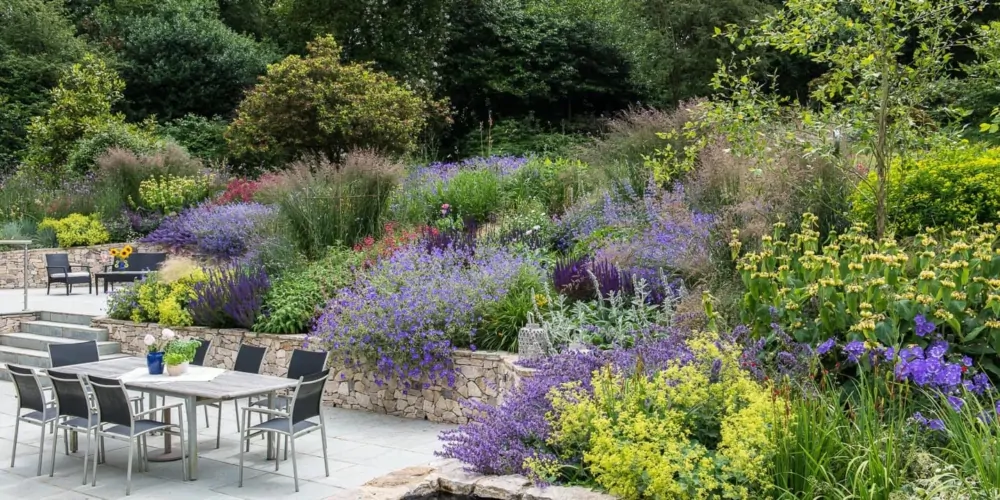
Raised beds and generous borders can soften a change in height while also improving the way the garden feels from both the house and the surrounding spaces. Plants brought closer to eye level can make a terrace feel more enclosed and inviting, while deep borders can reduce the visual impact of walls or abrupt banks.
Gardens with borders and raised beds are especially effective when they are integrated into the wider design rather than added as isolated features. They can frame a seating area, guide movement and create a gradual transition between upper and lower levels.
6. Use planting to connect the whole garden
Planting is what brings the different levels together. Repeating selected plants across the garden creates rhythm, while trees and larger shrubs can connect upper and lower areas visually. Plants that spill, spread or soften edges help structural elements feel settled rather than newly imposed.
Thoughtful planting design responds to the way conditions change across a sloping garden. Higher areas are often drier or more exposed, while lower ground may retain more moisture or sit in deeper shade.
Nic personally selects plants at the nursery and sets them out in the garden, considering their individual form, character and relationship with the surrounding scheme. This allows the planting to feel composed but not rigid, and gives each garden its own identity.
What should be avoided?
Many problems arise when a slope is treated as a construction exercise rather than a garden. Common mistakes include:
- Flattening too much and removing the natural character of the land
- Creating levels before deciding how they will be used
- Allowing walls, paving or steps to dominate the view
- Treating drainage as a problem to solve after construction
- Using too many unrelated materials
- Choosing plants without considering the conditions on each level
- Designing from a plan without studying views from inside the house
- Forgetting how the garden will be accessed and cared for as it matures
A slope can add more than practicality
A well-designed slope can give a garden qualities that are harder to achieve on completely flat ground. It can create natural separation between dining, entertaining and quieter areas without relying on fences or obvious divisions. It can frame views, offer shelter and bring planting into closer contact with the people using the space.
The most successful split-level gardens do not feel like a series of technical solutions. They feel generous, atmospheric and easy to move through, with each part contributing to the experience of the whole.
Designing sloping gardens in Surrey and the South East
Across Surrey, Sussex and the wider South East, sloping gardens vary enormously. Some rise sharply away from the house, while others fall towards open views or contain smaller level changes created over time. Clay soils, mature trees, heritage properties and exposed sites can all add further considerations.
There is no standard formula. The design should respond to the architecture, landscape and the people who will live with the garden. It should also take a long-term view, considering how the planting will establish, mature and be cared for after the main work is complete.
Our garden aftercare service helps protect that original design intent, supporting the garden as it develops through the seasons and over the years.
Turning a difficult slope into a defining feature
A sloping garden is not necessarily a compromised one. With a clear design, it can become a sequence of useful, beautifully planted spaces with greater depth and character than a flat site might offer.
If your garden feels steep, disconnected or underused, book a consultation to explore how its levels could be shaped into a garden that feels natural to the site and personal to the way you live.